
Master Machine Learning & Build Predictive Models
Learn how machines identify patterns, make predictions and learn from data. Explore Machine Learning algorithms, Python, feature engineering, model evaluation and real-world predictive analytics through hands-on practical projects.
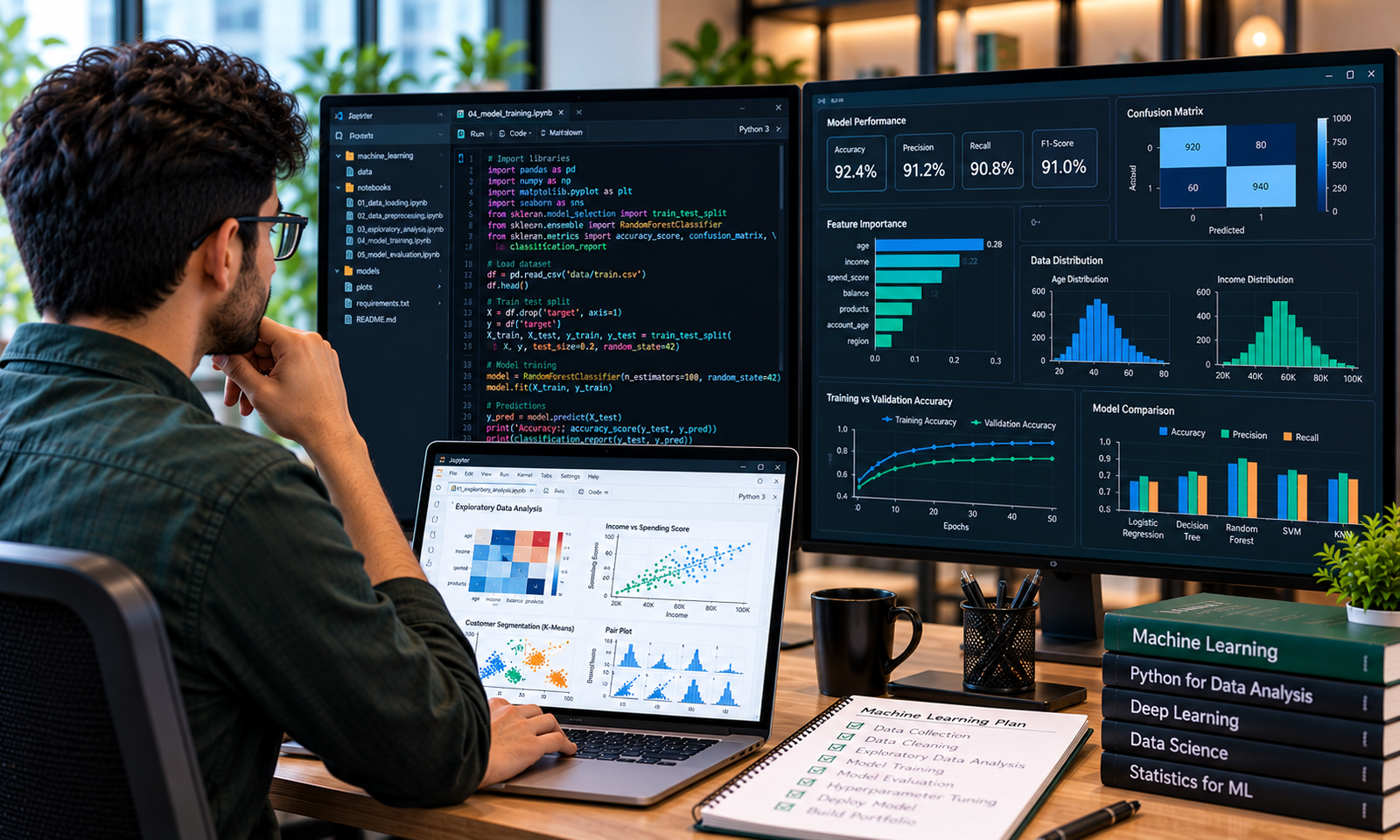
Understand how algorithms learn from data and generate predictions.
Build models using Python and widely used Machine Learning libraries.
Measure accuracy, identify errors and improve model performance.
Practice applying ML algorithms to realistic datasets.
Learn How to Build Models That Learn from Data.
Machine Learning is a field
of Artificial Intelligence
focused on developing systems
that learn patterns from data.
This course covers Python
programming, data preprocessing,
supervised learning,
unsupervised learning,
model evaluation and
feature engineering.
Learn how to train models,
interpret predictions,
tune algorithms and
apply Machine Learning
techniques to practical
business problems.
Machine Learning Skills You'll Develop
Build a foundation in data preparation, ML algorithms, predictive modeling and performance evaluation.
Python for Machine Learning
Learn Python, NumPy, Pandas and data manipulation techniques for ML workflows.
Supervised Learning
Understand regression, classification and predictive algorithms trained on labeled data.
Unsupervised Learning
Explore clustering, dimensionality reduction and pattern discovery in unlabeled datasets.
Feature Engineering
Prepare datasets, handle missing values, encode categories and scale features.
Model Evaluation
Apply evaluation metrics, cross-validation, confusion matrices and model comparisons.
Model Optimization
Explore hyperparameter tuning, pipelines, overfitting prevention and model improvement.
Machine Learning Tools You'll Explore
Learn popular Python libraries, algorithms and tools used in Machine Learning.
Machine Learning Course Syllabus
A structured roadmap covering Python, data preparation, ML algorithms, model training, optimization and practical projects.
Module 01 — Introduction to Machine Learning
- What is Machine Learning?
- AI vs ML vs Deep Learning
- Real-world ML applications
- Types of Machine Learning
- Understanding the ML workflow
- Introduction to datasets and features
- Common ML challenges
Module 02 — Python & Data Analysis Foundations
- Python programming basics
- Variables, loops and functions
- Lists and dictionaries
- NumPy arrays
- Pandas DataFrames
- Importing CSV datasets
- Data filtering and grouping
- Basic data visualization
Module 03 — Mathematics & Data Preprocessing
- Statistics fundamentals
- Probability concepts
- Linear algebra basics
- Handling missing values
- Encoding categorical data
- Feature scaling and normalization
- Train-test splitting
- Data leakage prevention
Module 04 — Regression Algorithms
- Introduction to supervised learning
- Simple Linear Regression
- Multiple Linear Regression
- Polynomial Regression concepts
- Regularization fundamentals
- MAE, MSE and RMSE
- R-squared
- Regression model project
Module 05 — Classification Algorithms
- Introduction to classification
- Logistic Regression
- K-Nearest Neighbors
- Decision Tree Classifier
- Random Forest Classifier
- Support Vector Machines
- Naive Bayes basics
- Classification practice exercises
Module 06 — Unsupervised Learning
- Introduction to unsupervised learning
- K-Means Clustering
- Choosing cluster counts
- Hierarchical clustering basics
- DBSCAN overview
- Principal Component Analysis
- Dimensionality reduction
- Customer segmentation project
Module 07 — Model Evaluation & Validation
- Training and testing models
- Bias and variance
- Overfitting and underfitting
- Confusion matrix
- Accuracy, precision and recall
- F1-score
- ROC-AUC fundamentals
- Cross-validation
Module 08 — Feature Engineering & Optimization
- Feature selection
- Feature transformation
- Handling imbalanced datasets
- Scikit-learn pipelines
- GridSearchCV
- RandomizedSearchCV
- Hyperparameter tuning
- Comparing model performance
Module 09 — Model Deployment Fundamentals
- Saving trained models
- Loading models for prediction
- Introduction to Streamlit
- Creating a basic prediction interface
- Model input validation
- Introduction to APIs
- Deployment workflow overview
- Monitoring and model limitations
Module 10 — Machine Learning Capstone Projects
- Selecting a business problem
- Dataset exploration
- Data cleaning and preprocessing
- Algorithm selection
- Model training
- Model evaluation and tuning
- Building a prediction application
- GitHub project documentation
- Final project presentation
Build Real-World Machine Learning Projects
Apply ML techniques to practical prediction, classification and clustering problems.
House Price Prediction
Build a regression model to estimate house prices using property features. Evaluate model performance and compare predictions.
Customer Churn Prediction
Develop a classification model to identify customers who may stop using a service. Explore important features and classification metrics.
Customer Segmentation
Use clustering algorithms to group customers based on purchasing patterns and visualize meaningful customer segments.
Develop Skills for Machine Learning Careers.
Machine Learning is used in
recommendation systems,
fraud detection,
customer analytics,
forecasting and
intelligent applications.
Python, Scikit-learn,
data preprocessing and
model development skills
can support several
technical career paths.
Advanced roles generally
require strong programming,
mathematical knowledge
and production ML experience.
Questions About Machine Learning
Can beginners learn Machine Learning?
Is Python required for Machine Learning?
Does the course cover supervised and unsupervised learning?
Will I learn Scikit-learn?
Is Deep Learning included?
Are practical Machine Learning projects included?
Ready to Build Your First Machine Learning Model?
Explore Machine Learning training with Placify India and develop practical skills in Python, ML algorithms, model evaluation, predictive analytics and real-world projects.